AI is easy to try.
Open ChatGPT. Ask it to write something. Upload a document. Generate an image. Ask for ideas.
You can get your first result in minutes.
But using AI once isn't the same as adopting AI.
For many Nigerian SMEs, the pattern looks something like this:
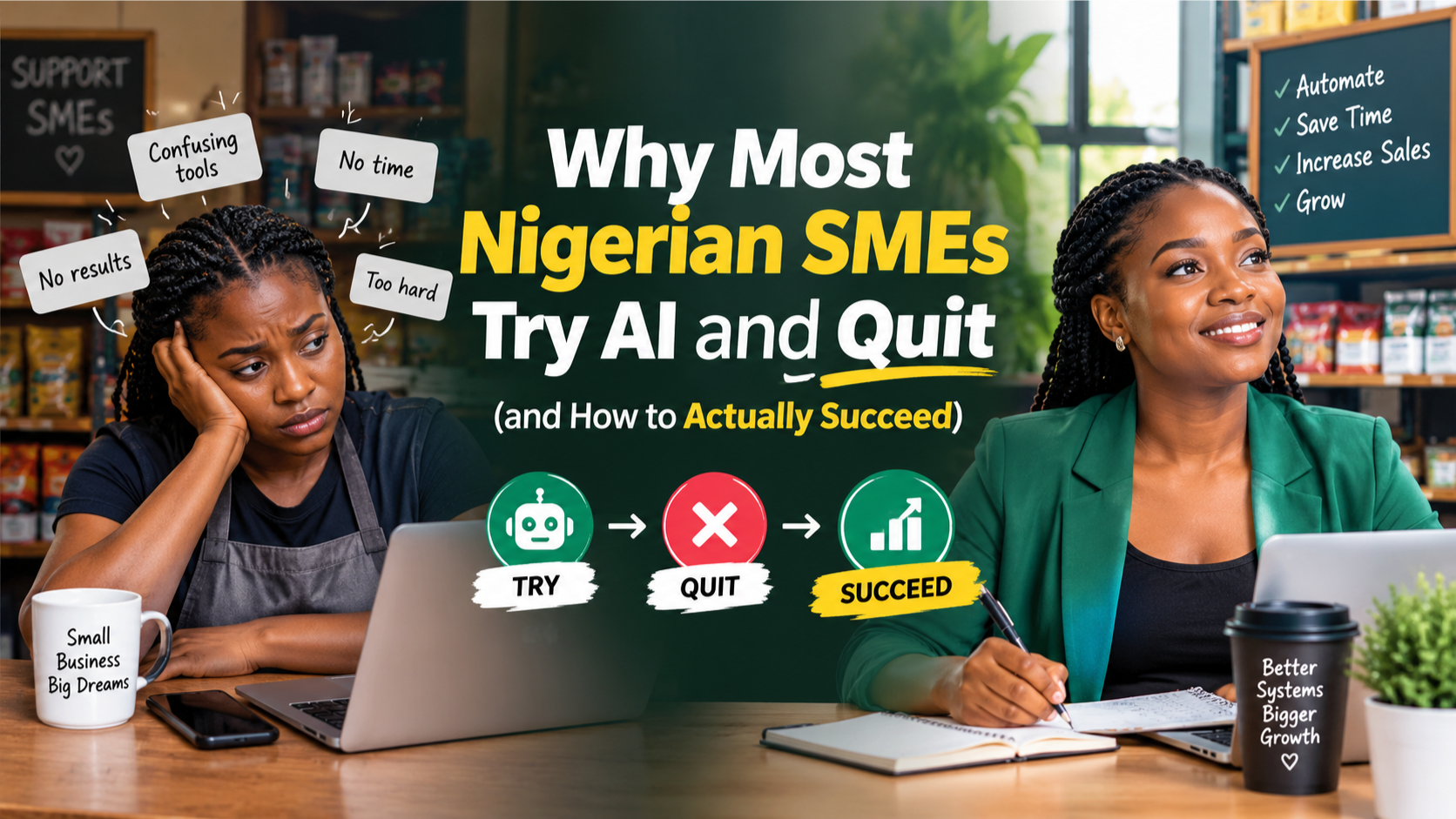
Try AI → get excited → use it for a few weeks → hit a problem → stop using it.
The technology gets blamed.
But the real problem is usually somewhere else.
Recent research on Nigerian SMEs points to a combination of cost, infrastructure, skills, organisational readiness, local relevance, data concerns, and resistance to changing established ways of working. A 2026 study of 319 SME owners in Nigeria found that technological, organisational and environmental barriers all influence generative AI adoption, with environmental constraints having the strongest effect.
The good news is that this doesn't mean Nigerian SMEs should stay away from AI.
It means they need to approach it differently.
The Nigerian SME AI adoption problem
Nigeria has a huge small-business economy.
The 2025 AI Readiness of Nigerian SMEs study by Enterprise Development Centre (EDC) at Pan-Atlantic University and eTranzact surveyed 5,290 SMEs across all 36 states and the Federal Capital Territory, alongside focus-group discussions involving 212 participants across five states. The study found growing awareness and enthusiasm around AI, but also significant barriers to actual adoption.
BusinessDay reported that AI awareness is particularly visible in sectors such as ICT and creative industries, while adoption remains lower in areas including agriculture and fashion. The same reporting identified high implementation costs, inadequate infrastructure, limited technical expertise, lack of local adaptation, data privacy concerns and regulatory issues as barriers.
So the question isn't whether Nigerian business owners have heard about AI.
They have.
The harder question is:
How do you make AI useful enough that your team keeps using it?
Why Nigerian SMEs try AI and then stop
1. They start with the tool instead of the problem
This is probably the most common mistake.
A business owner sees a new AI tool and asks:
"What can I use this for?"
That's backwards.
Start with:
"What problem in my business is costing me time or money?"
Maybe your sales team spends hours responding to the same customer questions.
Maybe someone manually turns enquiries into records.
Maybe your team spends half a day preparing a weekly report.
Maybe staff repeatedly summarize documents.
Maybe your business has hundreds of customer messages but no consistent way to identify serious leads.
Those are business problems.
AI is simply one possible way to solve some of them.
When you start with a tool, you can easily end up with a solution looking for a problem.
2. The first experiment is too ambitious
Another common mistake is trying to introduce AI everywhere at once.
Customer service.
Marketing.
Sales.
Operations.
Accounting.
HR.
Content.
Reporting.
It sounds impressive.
It is also a good way to overwhelm your team.
A better approach is to choose one workflow.
For example:
Customer enquiry → AI-assisted classification → route to the right person → update customer record
Or:
New document → extract important information → structure it → send it to the appropriate system
Or:
Customer questions → identify common questions → prepare suggested responses → human reviews and sends
One working workflow is more valuable than ten AI experiments nobody maintains.
3. The business doesn't have the digital foundation AI needs
AI doesn't exist separately from your business.
It needs information.
It needs processes.
It needs people who know what should happen next.
It may need access to your existing systems.
If your customer information is scattered across WhatsApp chats, notebooks, spreadsheets and individual staff phones, adding AI doesn't automatically fix the underlying problem.
Research reviewing 27 peer-reviewed studies and four policy or industry reports found that many Nigerian SMEs lack the basic digital foundations needed for scalable AI adoption. The review identified unreliable infrastructure and power, limited data readiness, skills shortages, financing constraints and regulatory uncertainty among the dominant barriers.
This leads to an important point:
AI adoption is partly a systems problem.
Before asking what AI can do, ask whether your business has a process for AI to work inside.
4. The cost doesn't make sense yet
AI tools are more accessible than they were a few years ago.
But "accessible" doesn't mean free.
There can be costs for:
- Software subscriptions
- API usage
- Internet data
- Devices
- Implementation
- Staff training
- Integration
- Maintenance
- Security
- Human review
BusinessDay has repeatedly highlighted cost as a major barrier for Nigerian SMEs. One 2025 report noted that businesses can face not only software costs but also the cost of hardware, network improvements and employee training.
For a Nigerian SME, this matters.
A tool might cost a relatively small amount in dollar terms but still be difficult to justify when converted to naira and added to an already tight operating budget.
So don't ask:
"Is this AI tool affordable?"
Ask:
"What will this tool save or generate?"
If an automation saves your team 30 hours every month, that gives you something to measure.
If it reduces errors that regularly cost the business money, measure that.
If it increases qualified leads, measure that.
If nobody can explain what the investment is supposed to improve, the business probably isn't ready to pay for it yet.
5. Someone uses AI, but nobody owns the process
This is where many experiments quietly die.
One enthusiastic employee discovers an AI tool.
They start using it.
They create prompts.
They develop a workflow.
Then they get busy.
Or they leave.
Or nobody else knows how the process works.
The AI experiment disappears.
That's not a technology failure.
It's an ownership problem.
If AI becomes part of a business process, somebody needs to own that process.
The team also needs to know:
- What the AI does
- What information it receives
- What output it produces
- What requires human review
- What happens when the AI gets something wrong
- Who maintains the workflow
Without that structure, adoption depends on enthusiasm.
And enthusiasm doesn't scale.
6. The output isn't local enough
This is a particularly important issue for Nigerian businesses.
AI tools can produce technically correct answers that still don't fit the business.
A customer-facing message may sound too foreign.
A marketing example may assume a different market.
A recommendation may ignore Nigerian payment habits, customer expectations, pricing realities or local business practices.
BusinessDay's reporting on AI adoption in Nigeria has highlighted the need for culturally and linguistically relevant AI tools. The EDC/eTranzact study similarly identified lack of local adaptation as one of the barriers to adoption.
This doesn't mean AI is incapable of working for Nigerian businesses.
It means the business needs to provide the right context.
The better approach is to give AI:
- Your actual business information
- Your customer profile
- Your products or services
- Your pricing
- Your brand voice
- Your operating rules
- Examples of good and bad outputs
- Clear instructions about what it should and shouldn't do
AI becomes much more useful when it is working inside a defined business context.
7. People are afraid of what AI will change
Technology adoption is also a people problem.
Employees may worry that AI will replace their jobs.
Managers may worry that employees will misuse AI.
Business owners may worry about losing control over customer information.
Others simply don't trust the output.
These concerns shouldn't be dismissed.
A 2025 study published in PLOS ONE found that SME AI integration can be held back by internal factors including reluctance to change, fear of job displacement and limited resources.
The answer isn't to tell employees:
"Don't worry. AI is the future."
Show them exactly what the system will do.
For example:
Before: Staff member spends two hours sorting enquiries.
After: System sorts the enquiries automatically; staff member reviews the results and handles the cases that need human attention.
That is easier to understand.
The conversation changes from "AI is replacing me" to "AI is removing part of the repetitive work I don't need to spend my day doing."
8. They expect AI to work perfectly
It won't.
AI can produce incorrect information.
It can misunderstand context.
It can generate an answer that sounds confident but is wrong.
That's why AI should not automatically be given responsibility for decisions that require human judgment.
Instead, define where AI can act independently and where a person must review the result.
For example:
AI can: classify incoming enquiries.
Human reviews: unusual or high-value enquiries.
AI can: draft a response.
Human approves: sensitive customer communication.
AI can: summarize a report.
Human decides: what action to take.
This makes AI part of a controlled workflow rather than an unchecked decision-maker.
The research points to a better approach
Recent Nigerian research is increasingly pointing toward gradual, structured adoption rather than simply telling SMEs to "embrace AI."
A 2026 study published in the Journal of the International Council for Small Business, based on 319 Nigerian SME owners, found that technological, organisational and environmental barriers significantly affect GenAI adoption. It also highlighted knowledge assimilation—the ability of a business to learn and absorb new knowledge—as an important mechanism in responding to those pressures.
A separate 2025 systematic review of Nigerian SME AI adoption reached a similar practical conclusion: businesses need stronger digital capability, organisational readiness and ecosystem support, alongside staged adoption.
In other words:
Don't just buy AI. Build the capability to use it.
So how should a Nigerian SME actually adopt AI?
Here's a more practical approach.
Step 1: Find one repetitive problem
Don't start with "AI."
Start with the work.
Look for something your team does repeatedly.
Examples:
- Sorting customer enquiries
- Drafting routine content
- Summarising documents
- Preparing internal reports
- Categorising support requests
- Extracting information from documents
- Moving information between systems
Choose one.
Step 2: Measure the current process
Before changing anything, understand what the current process costs.
Ask:
- How often does it happen?
- How long does it take?
- How many people touch it?
- Where do errors happen?
- What happens when someone is unavailable?
- What does a delay cost the business?
You don't need a complicated spreadsheet.
You need a baseline.
Without one, it becomes difficult to know whether AI actually helped.
Step 3: Decide whether AI is actually necessary
This is important.
Not every automation needs AI.
Sometimes a simple rule-based automation is better.
For example:
When a form is submitted → add the information to the CRM → notify the sales team.
You don't need AI for that.
But if the system needs to read the enquiry, identify the customer's intent and route it based on the content, AI may be useful.
The best system is not the one with the most AI.
It's the one that solves the problem reliably.
Step 4: Start small
Build a pilot.
One workflow.
One team.
One measurable outcome.
Give it enough time to see whether people actually use it.
Then improve it.
If it works, expand.
If it doesn't, find out why before spending more money.
Step 5: Train the people using it
Training shouldn't mean showing employees how to open ChatGPT.
It should explain how AI fits into their actual work.
For example:
When this happens → the system does this → you review this part → if X happens, do Y.
That's a workflow people can understand.
Step 6: Put guardrails around sensitive information
Data privacy cannot be an afterthought.
The EDC/eTranzact study identified data privacy concerns as one of the barriers to AI adoption among Nigerian SMEs.
Before putting customer, employee or business information into an AI system, determine:
- What data is being used
- Where it is going
- Who can access it
- What the AI provider does with it
- What information should never be submitted
- Where human approval is required
For sensitive workflows, the technical setup matters just as much as the AI capability.
Step 7: Measure the result
After implementation, compare the new process with the old one.
Measure something tangible:
- Hours saved
- Response time
- Number of tasks completed
- Error rate
- Leads processed
- Customer response rate
- Cost per process
- Revenue generated
AI adoption becomes much easier to justify when the business can point to a result.
What successful AI adoption looks like
Successful AI adoption doesn't necessarily look impressive from the outside.
There may be no flashy AI chatbot on the website.
No futuristic dashboard.
No announcement that the company is now "AI-powered."
Instead, something simple happens.
A customer enquiry gets routed automatically.
A report that took three hours takes 30 minutes.
A team stops copying information between systems.
A manager gets the information they need without asking three people.
A repetitive customer-support task is handled automatically while unusual cases go to a person.
The technology becomes part of the operation.
And eventually, people stop thinking about the AI.
They just know the system works.
AI doesn't have to replace your current systems
This is another important distinction for Nigerian SMEs.
You don't necessarily need to throw away everything you currently use.
Your business may already have:
- Google Workspace
- A CRM
- Spreadsheets
- Accounting software
- Project management tools
- Forms
- Customer databases
The first opportunity may simply be to connect the systems you already have.
For example:
Form → AI qualification → CRM → sales notification
Instead of:
Form → spreadsheet → manual review → WhatsApp message → CRM → follow-up
That's the difference between using several digital tools and having a connected system.
What if your business isn't ready for AI yet?
That's okay.
In fact, knowing that you're not ready can save you money.
If your processes are inconsistent, your data is scattered, or your team doesn't understand the workflow, fix those foundations first.
You may discover that the first improvement isn't AI at all.
It might be:
- Documenting the process
- Cleaning your data
- Connecting existing tools
- Removing duplicate steps
- Creating a proper customer database
- Standardising how information is captured
- Automating a simple rule-based task
Once the foundation is stronger, AI becomes easier to apply.
The real goal is not AI adoption
This is the part many businesses miss.
You don't actually need an AI strategy just for the sake of having one.
You need a better way to run the business.
AI is one tool that can help.
Automation is another.
Custom software is another.
Better processes are another.
The goal is to combine the right pieces.
For some Nigerian SMEs, that may mean using AI to handle part of customer support.
For another business, it may mean automating lead routing.
For another, it may mean connecting accounting, HR or project information.
And for another, it may mean building a custom internal tool because existing software doesn't fit the process.
The technology should follow the business problem.
Not the other way around.
Final takeaway
Most Nigerian SMEs don't need more AI experiments.
They need AI that survives the experiment stage and becomes useful enough to stay.
That requires more than a subscription.
It requires:
A real problem → a defined workflow → the right technology → trained people → clear safeguards → measurable results.
The research is increasingly clear that Nigerian SME AI adoption is affected by more than access to AI tools. Infrastructure, skills, organisational readiness, cost, local relevance and environmental conditions all influence whether adoption actually lasts.
So if you've tried AI and stopped using it, don't assume AI doesn't work for your business.
Ask a different question:
Did you actually integrate it into a business process?
That's where the difference between experimenting with AI and building with AI begins.
How Marex Ventures approaches AI and automation
At Marex Ventures, we don't start by asking a business which AI tool it wants to buy.
We start by looking at how the business currently works.
We map the workflow, review the tools already being used, identify repetitive manual work and find the points where information gets stuck or has to be moved manually.
From there, we determine whether the right answer is:
- Automation
- AI-assisted automation
- Connecting existing tools
- A custom internal tool
- Or simply fixing the process first
The starting point is a Workflow & Systems Audit.
The audit produces a Systems Blueprint that includes a view of the proposed system architecture, an ROI projection and a prioritized list of automation opportunities.
Because the goal isn't to make your business look more technical.
It's to make the business run better.
Frequently Asked Questions
Why do Nigerian SMEs struggle to adopt AI?
Research and industry studies point to several factors, including implementation costs, inadequate infrastructure, limited technical skills, lack of local adaptation, data privacy concerns, organisational readiness and resistance to changing existing processes.
Is AI too expensive for small businesses in Nigeria?
Not necessarily. The cost depends on the problem being solved, the tools required and the expected return. A small business should start with a specific workflow and compare the cost of implementation with measurable savings or additional output rather than assuming AI is either expensive or cheap.
Does every Nigerian SME need AI?
No. Some businesses may benefit more from basic automation, better data management or connecting existing software. AI should be used where it solves a real problem better than simpler alternatives.
What is the best way for an SME to start using AI?
Start with one repetitive business problem. Measure the current process, identify where AI can help, run a small pilot, train the people involved and measure the result before expanding.
Can AI work with the software my business already uses?
Often, yes. AI can be incorporated into workflows alongside existing tools. The exact approach depends on what systems the business uses and what information needs to move between them.
Should I automate a process before using AI?
Usually, you should first understand the process. Some tasks need AI because they involve interpretation or classification. Others are better handled by straightforward automation. The goal is to use the simplest reliable technology for the job.
What if my business tried AI and it didn't work?
Review the experiment rather than abandoning the technology completely. Ask whether the use case was clear, whether the workflow was properly defined, whether employees were trained, whether the output was useful and whether the result was measured. A failed experiment can show you what needs to change before the next one.