Running a business alone does not mean you have to manage everything manually. Yet many solo entrepreneurs spend hours switching between spreadsheets, messages, documents, email threads and separate tools just to keep their businesses moving.
For entrepreneurs exploring automation for solo entrepreneurs in Nigeria, the real opportunity is not necessarily to automate every task or invest in expensive enterprise software. It is to build a practical system that helps you manage the work you already do.
At Marex Ventures, this idea informed the development of the Marex Business Operating System: an internal business management system designed to connect essential activities, from finding potential clients to tracking project delivery.
This article explains the problem the system is designed to solve, how its different components fit together, and what other solo entrepreneurs can learn from the approach.
Why Solo Entrepreneurs Need Better Business Systems
When you run a business without a large team, you may be responsible for sales, client communication, administration, invoicing, service delivery and follow-up.
At first, managing these activities separately might seem manageable. You may keep leads in a spreadsheet, prepare proposals in a document, track invoices in another file and rely on WhatsApp messages to remember client requests.
The difficulty emerges as these activities begin to overlap.
A potential client may express interest but never receive a follow-up. A proposal may be sent without a reminder to check whether the client has responded. An invoice may remain outstanding while you focus on delivering another project. Important details from a client meeting may be scattered across notes and messages.
These are not necessarily problems caused by a lack of effort. They can be signs that the business needs a more connected way of working.
Business process automation can help by reducing repetitive administration and making routine processes more consistent. The first step, however, is understanding how the work should flow before deciding what to automate.
What Is the Marex Business Operating System?
The Marex Business Operating System is an internal system built to help organise the operational side of Marex Ventures.
Rather than treating lead generation, sales, onboarding, invoicing and project delivery as completely separate activities, the system brings them into a connected business workflow.
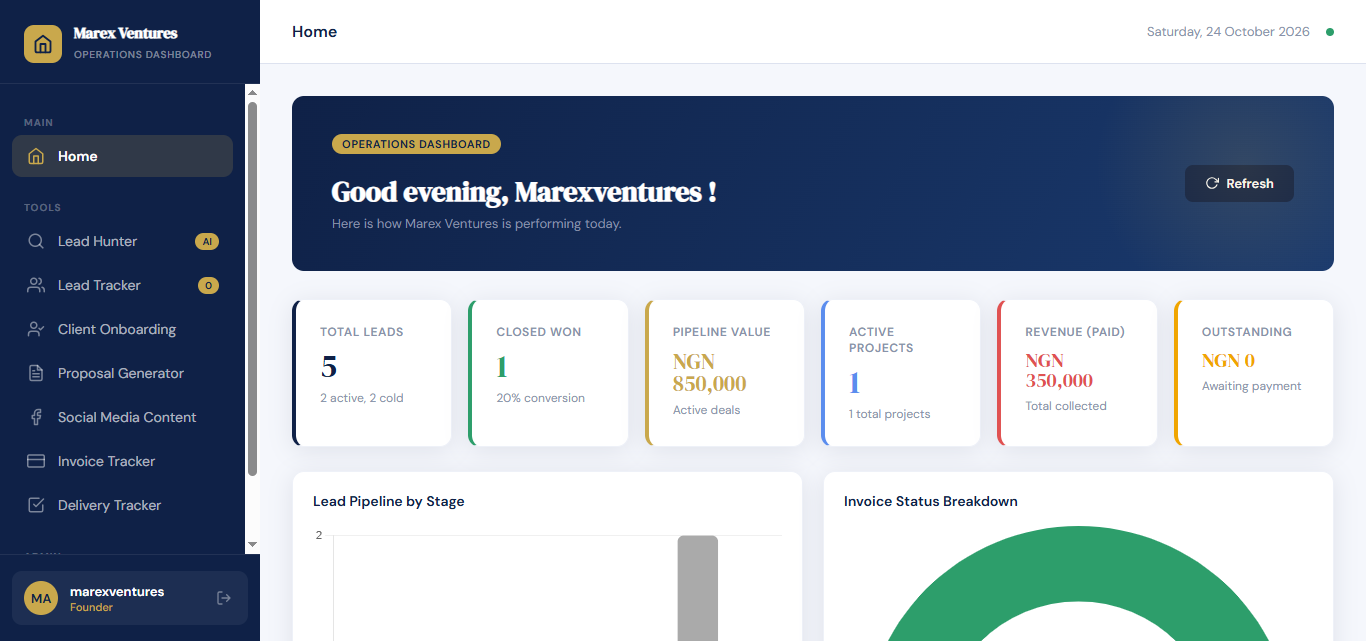
Its dashboard provides an overview of important business information, including:
- Total leads and closed leads
- Closed-won opportunities and pipeline value
- Active projects
- Revenue and outstanding amounts
- Recent leads and projects
- Invoice status
The goal is to make it easier to understand what is happening across the business without having to search through multiple disconnected records.
The system also includes seven tools designed to support different stages of the business process.
1. Finding and Tracking Potential Clients
A business cannot grow consistently if finding potential clients depends entirely on chance.
The Lead Hunter helps identify prospects based on selected criteria, including industry, business type, region, business size, search terms and the number of prospects to find. It also includes a LinkedIn search option.
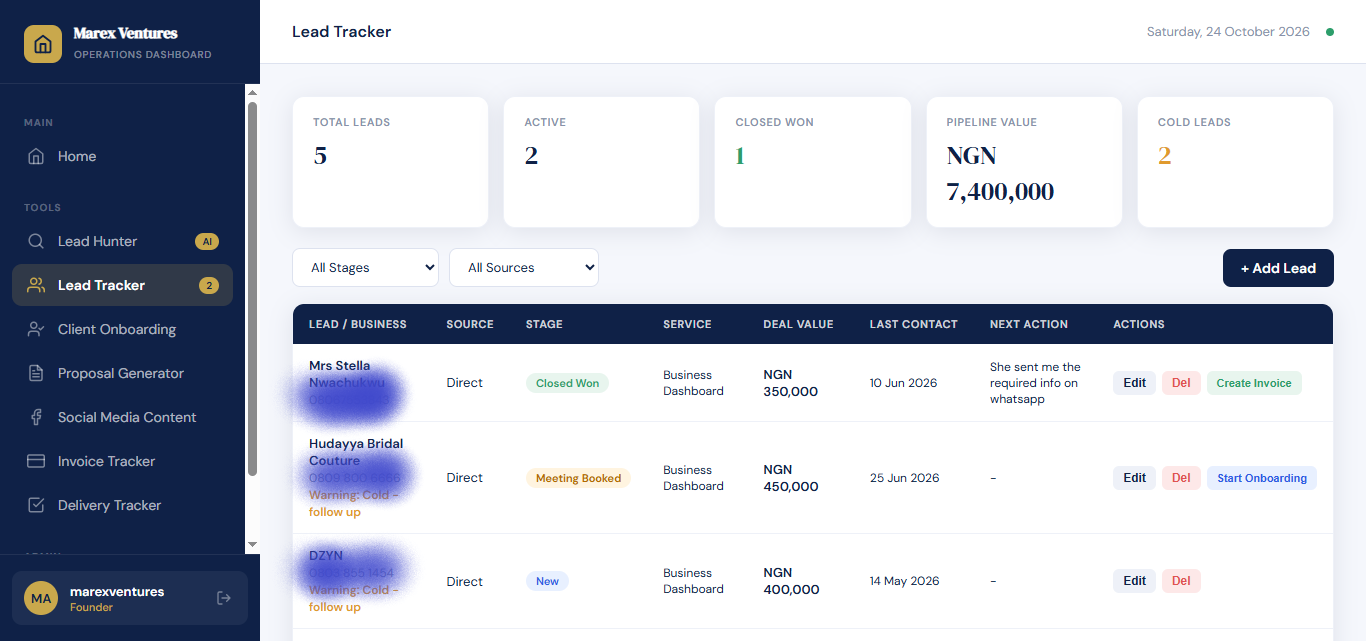
After identifying a suitable prospect, the information can move into the Lead Tracker.
The tracker records details such as:
- Business and contact information
- The prospect's potential pain point
- Services they may need
- Lead stage and estimated deal value
- Last action taken
- Notes and follow-up information
An AI-assisted action suggestion feature can help identify possible next steps for a lead.
This creates a more organized process: prospects can be researched, recorded and followed up on instead of remaining in a collection of browser tabs or scattered notes.
For a solo entrepreneur, this matters because finding a lead is only the beginning. There must also be a reliable way to manage what happens next.
2. Moving from a Lead to Client Onboarding
When a prospect becomes a client, the business needs to move from sales conversations to organized delivery.
The Marex Business Operating System includes a Start Onboarding function that transfers lead information into the client onboarding process.
This helps reduce the need to repeatedly enter the same details or reconstruct the client's history from previous conversations.
The principle is straightforward: information gathered during the sales process should remain useful when the business begins working with the client.
A connected onboarding process can help a solo entrepreneur establish what the client needs, what has been agreed and what information is required before work begins.
3. Turning Meetings into Project Briefs
Client conversations often contain important details about business goals, challenges, expectations and deliverables. If those details are not captured properly, they can be difficult to retrieve later.
The system includes AI-assisted meeting preparation and documentation features.
Before a meeting, the tool can generate questions based on the available client information. After the meeting, the entrepreneur can paste the discussion notes or transcript into the Post Meeting Brief tool.
The tool then generates a project brief from that information.
This creates a bridge between conversation and execution. Instead of relying only on memory, the entrepreneur has a structured document to refer to when preparing the proposal and planning the work.
AI is useful here as a support tool, not as a substitute for professional judgement. The generated brief should still be reviewed to confirm that it reflects the client's actual requirements.
4. Preparing Proposals and Tracking Invoices
Preparing proposals and following up on payments are important business activities, but they can become administrative distractions when handled inconsistently.
The Proposal Generator helps prepare a proposal using information such as the client, date, investment and timeline.
Once the proposal is ready and the engagement progresses, the workflow can continue into invoicing.
The Create Invoice function transfers the relevant information to the Invoice Tracker, where invoices and payment plans can be monitored. The system also supports tracking commissions associated with independent marketers.
This connection matters because sales activity, agreed investment and payment status are closely related.
A proposal should not disappear into a folder after it is sent. An invoice should not become difficult to track because the person managing the business is also responsible for marketing, delivery and administration.
A structured process makes it easier to see what has been sent, what is due and what requires attention.
5. Managing Project Delivery and Milestones
Winning a client is not the end of the business process. The agreed work must be delivered, reviewed and completed.
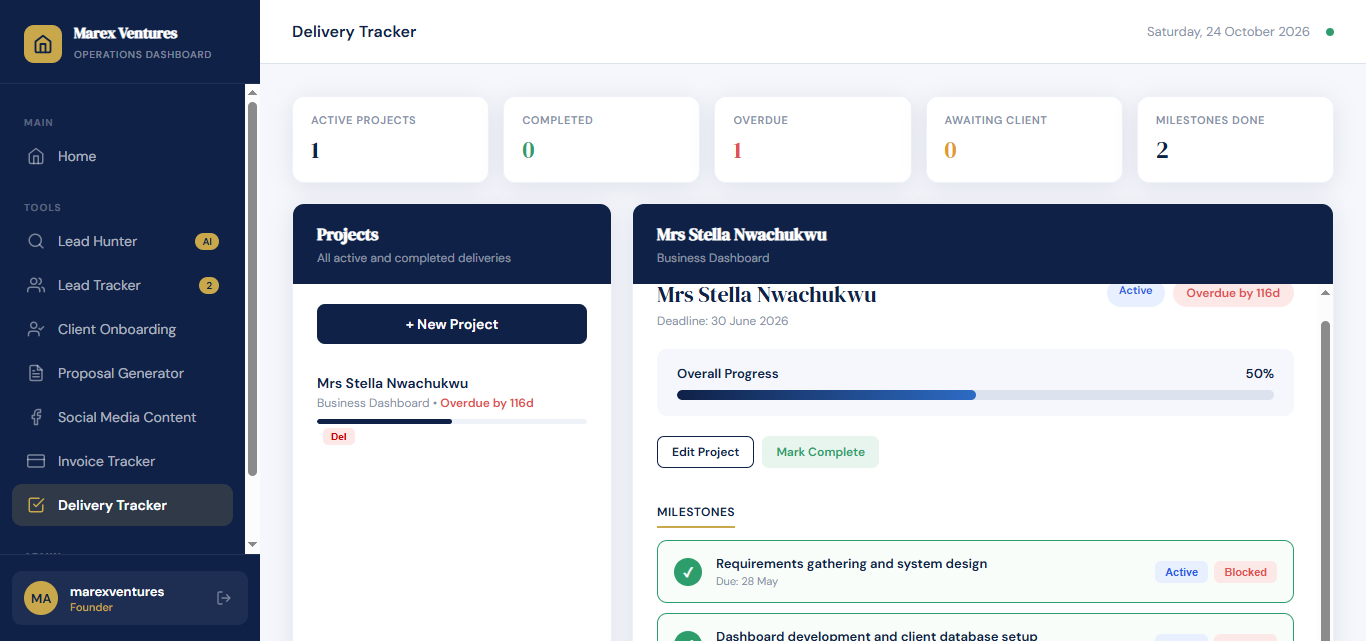
In the Marex Business Operating System, the Start Delivery function moves a project into the Delivery Tracker after the initial payment is received.
The Delivery Tracker helps organize project milestones and progress.
As work moves through the agreed stages, the entrepreneur can monitor what has been completed and what remains outstanding. Where the project agreement requires another payment before the next phase, a milestone can also prompt the next invoice.
Client feedback and approvals can be captured during the project, helping keep delivery and communication connected.
This is particularly useful for a solo service business, where the same person may be responsible for client acquisition, project management and the actual service delivery.
The aim is not to eliminate communication with clients. It is to make sure that important actions, milestones and payment requirements are easier to track.
6. Supporting Marketing After Client Discussions
The system also includes a Social Media Campaign Generator.
It accepts inputs such as a product or service name, description, target audience, key benefit, call to action, platform and number of posts. It can then generate campaign ideas and draft content.
Because the tool can draw on information from client discussions, it can help connect what the business has learned about a client's needs with the content created for that client.
The generated content still requires human review. The entrepreneur needs to confirm that the messaging reflects the client's brand, the agreed campaign objectives and the information provided.
This is an example of using AI within a defined business process rather than treating it as a standalone content generator.
How the Workflow Connects
The individual tools become more useful when they work together as part of a larger process.
A simplified view of the intended workflow looks like this:
Prospect research → Lead tracking → Client onboarding → Meeting preparation → Project brief → Proposal → Invoice tracking → Project delivery → Client feedback and marketing support
Each stage has a purpose. Information gathered early in the process can inform later decisions, while the status of a lead, invoice or project becomes easier to track.
Not every business needs this exact workflow. A product seller, consultant, training provider and service agency may have different processes. The important lesson is to design a workflow around the way the business actually operates.
What Solo Entrepreneurs Can Learn from This Approach
The Marex Business Operating System offers several practical lessons for entrepreneurs who want to improve how they manage their businesses.
Start with the process, not the software
Before choosing an automation platform or building a custom tool, map how work currently moves through the business.
Identify where information is collected, who acts on it, what happens next and where delays or errors occur.
A workflow audit can help reveal which problems need a process change, which need better record-keeping and which could benefit from automation.
Connect related activities
A collection of useful tools does not automatically create an effective business system.
The value increases when one stage supports the next. For example, lead information should help with onboarding, meeting notes should inform the proposal, and project milestones should support delivery and payment tracking.
Automate repetitive administration first
Look for tasks that happen repeatedly and follow reasonably predictable rules.
Examples include recording leads, preparing standard documents, updating project statuses, tracking invoice due dates and organising meeting notes.
Keep human review in place wherever a task involves important financial decisions, client commitments, sensitive information or professional judgement.
Use AI where it has a clear job
AI can help summarise discussions, suggest follow-up actions, prepare draft proposals and generate campaign content.
However, AI does not remove the need to verify information, understand client requirements or make sound business decisions.
The best use cases have a defined input, a useful output and a person responsible for reviewing the result.
Build around your actual business needs
A solo entrepreneur does not necessarily need a complex enterprise platform. Depending on the business, a well-structured spreadsheet, a few connected applications or a custom internal system may be enough.
The right solution is the one that solves the real operational problem without creating unnecessary cost or complexity.
Should You Build a Custom Business Operating System?
A custom system may be worth considering when several parts of a business need to work together and existing tools are not meeting those requirements.
It may be especially relevant when a business has recurring processes for managing prospects, onboarding clients, preparing proposals, tracking invoices or delivering projects.
However, custom software is not always the right starting point.
If the process is still unclear, building a tool may simply make an inefficient process digital. If an existing application already meets the need, adopting it may be more practical than creating something new.
Before investing in a custom system, consider:
- Which business processes are causing the most difficulty?
- How often does the problem occur?
- What information needs to move between stages?
- Can existing tools solve the problem?
- What would a custom solution need to do that current tools cannot?
- Who will maintain the system and ensure it remains useful?
A workflow audit can help answer these questions before a business commits to automation or custom software development.
How Marex Ventures Approaches Business Automation
At Marex Ventures, the starting point is understanding how a business works before deciding what technology it needs.
Our Workflow & Systems Audit helps identify process bottlenecks, unnecessary manual work and opportunities to improve operations. The resulting Systems Blueprint includes a system architecture diagram, an ROI projection and an actionable automation list.
Where appropriate, we can then help businesses implement automation systems or build custom tools around their operational needs.
The Marex Business Operating System reflects the same principle in our own business: connect the activities that matter, make information easier to manage and create a more structured path from opportunity to delivery.
If your business relies on scattered spreadsheets, repeated data entry or memory to keep essential activities moving, you may not need more tools. You may need a better-connected system.
Explore Marex Ventures' Workflow & Systems Audit, Automation Systems and custom tools to identify the right next step for your business.
Frequently Asked Questions
What is business automation for solo entrepreneurs?
Business automation for solo entrepreneurs involves using connected tools, defined workflows and, where appropriate, AI to reduce repetitive administrative work. Examples include lead tracking, meeting documentation, invoice reminders and project status updates.
Can a solo entrepreneur benefit from automation?
Yes. Automation can help a solo entrepreneur manage recurring tasks more consistently and reduce the need to move information manually between tools. The best starting point is a process that occurs frequently and has a clear, repeatable sequence.
Does automation require custom software?
No. Many workflows can be improved with existing applications and automation platforms. Custom software becomes worth considering when a business has specific requirements that existing tools do not adequately meet.
What should a solo business automate first?
Start by identifying repetitive tasks that consume time, create avoidable errors or cause important actions to be missed. Lead follow-up, data entry, document preparation and invoice tracking can be useful candidates, depending on how the business operates.
Is AI necessary for business automation?
No. Many valuable automations rely on straightforward rules, triggers and actions without AI. AI is most useful when a workflow involves tasks such as summarising information, interpreting text or producing a draft that a person can review.
How can I tell whether my business needs a workflow audit?
Consider a workflow audit if work is frequently delayed, information is scattered across tools, the same details are entered repeatedly or you are unsure which tasks should be automated. An audit can help you understand the underlying process before investing in a solution.
Final Thoughts
Running a business alone does not mean every operational task must depend on your memory, manual effort or constant attention.
A practical business system gives recurring activities a defined structure, keeps related information connected and helps you see what needs attention.
The goal is not to automate everything. It is to build a business that is easier to manage, one process at a time.