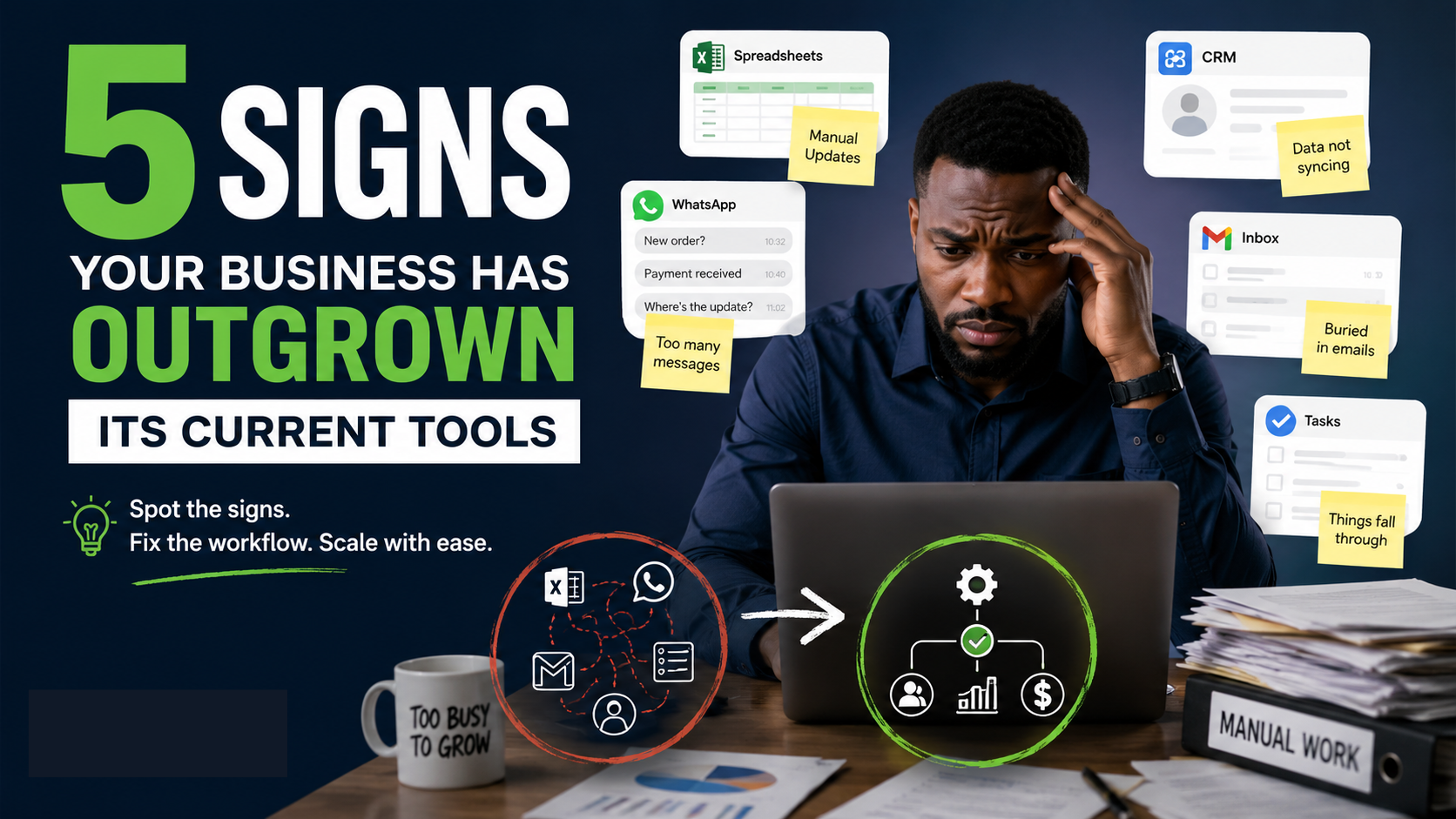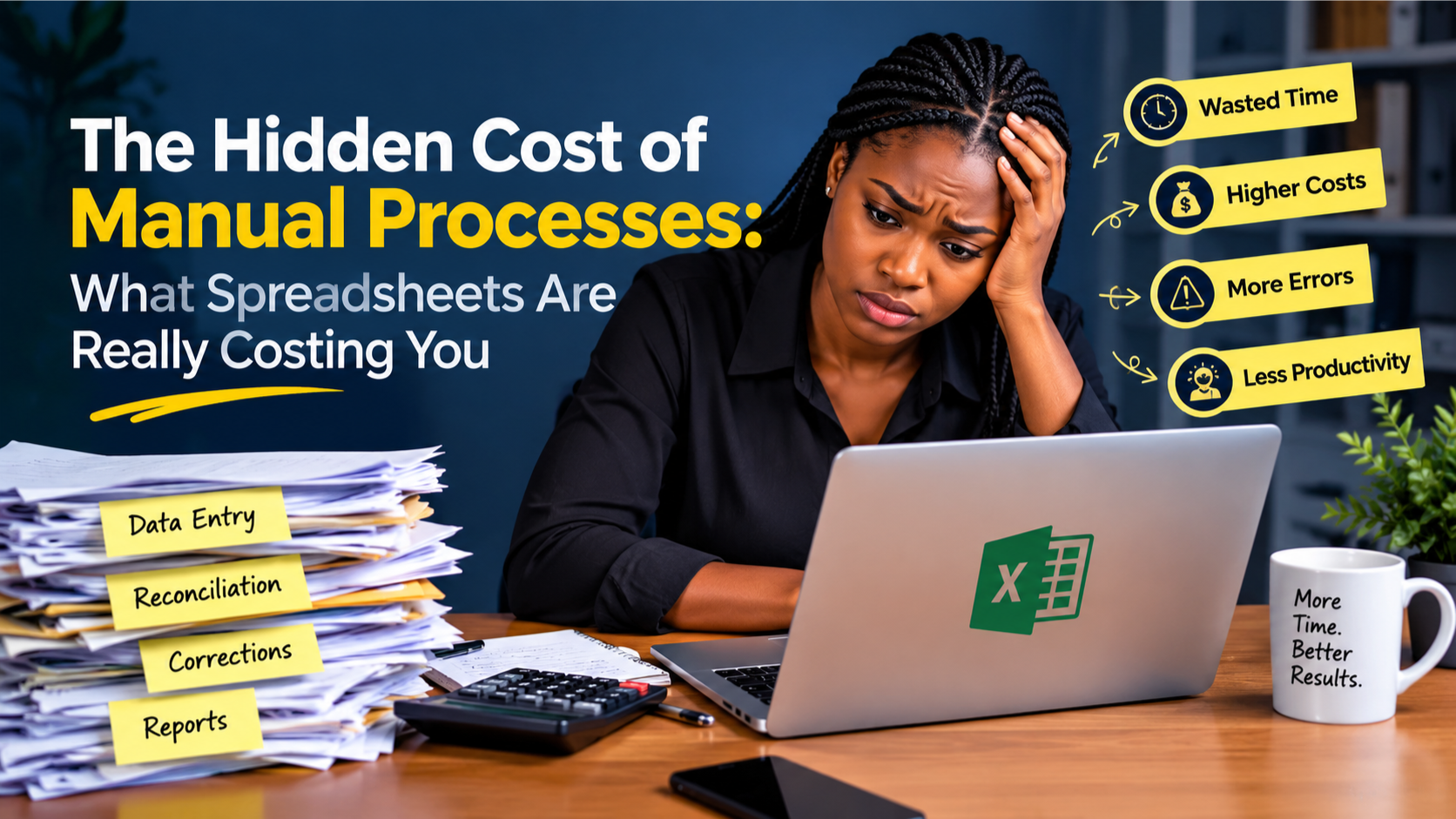
Spreadsheets are useful.
They help you track sales, manage expenses, monitor inventory, organize customers, prepare reports, and keep a business running.
The problem starts when your spreadsheet becomes the system your entire business depends on.
If your team is constantly updating spreadsheets, copying information from one file to another, checking whether someone has completed a task, or fixing errors caused by manual data entry, the real cost is much higher than the time spent typing.
This is the hidden cost of manual processes.
And for a growing business, that cost can quietly become significant.
What is the hidden cost of manual processes?
The obvious cost of manual work is time.
Someone spends 30 minutes updating a spreadsheet.
Another person spends an hour preparing a report.
Someone else checks three different files before responding to a customer.
But time isn't the only cost.
Manual processes can also create:
- Repeated data entry
- Human errors
- Delayed decisions
- Missed follow-ups
- Poor visibility
- Bottlenecks
- Dependence on specific employees
- More administrative work as the business grows
The bigger problem is that these costs often don't appear as a separate line on your financial statements.
You simply notice that your team is always busy.
1. You're paying people to move information around
Consider a simple sales process.
A potential customer submits an enquiry.
Someone receives it.
They copy the customer's details into a spreadsheet.
Then they enter the same information into a CRM.
Someone sends a message to the sales team.
The salesperson updates another spreadsheet after speaking with the customer.
At each step, a person is moving information from one place to another.
None of that work directly serves the customer.
It is administrative work created by the way the business is set up.
When this happens occasionally, it may not matter.
When it happens hundreds of times, it becomes an operational cost.
The same thing happens with HR records, project information, customer requests, reports, and other business data.
Your team may look productive because they are constantly working.
But being busy isn't the same as creating value.
2. Small errors become expensive over time
Manual processes also create opportunities for mistakes.
Someone enters the wrong figure.
A name is misspelled.
A row is skipped.
An old version of a spreadsheet gets updated instead of the current one.
A customer record isn't updated after a conversation.
A task gets forgotten because nobody received the information they needed.
One small mistake may not cause much damage.
But repeated mistakes can create a pattern.
Your team then spends more time checking work, correcting information, and figuring out what went wrong.
That is another hidden cost.
Instead of using your team's time to serve customers or improve the business, you're using it to repair the process.
3. Your reports take too long to prepare
How long does it take your business to answer a simple question?
For example:
How many new leads came in this month?
If the answer requires opening multiple spreadsheets, checking WhatsApp messages, asking different team members for updates, and manually combining the information, you have a visibility problem.
The information exists.
But it isn't available in a useful form.
This matters because business decisions depend on timely information.
If it takes three days to prepare a report, you may already be making decisions based on information that is out of date.
A connected system can reduce some of this manual work by allowing information to move between the tools your business already uses.
4. Your business becomes dependent on specific people
This is one of the most overlooked costs of manual work.
Imagine one employee is responsible for updating the master spreadsheet every evening.
They know which tabs to update.
They know which figures need checking.
They know which information comes from which source.
They know what to do when something doesn't match.
Then they go on leave.
Suddenly, nobody is completely sure how the process works.
The problem isn't the employee.
The problem is that the process exists mainly in the employee's memory.
A healthy business should document important processes and reduce unnecessary dependence on one person remembering every step.
Automation can help with repeatable parts of that workflow.
The system handles the predictable steps.
People handle the decisions that actually require judgment.
5. Growth makes the problem worse
Manual work can be manageable when the business is small.
You have 20 customers.
You have one salesperson.
You receive a few enquiries every week.
You can probably keep track of things manually.
Then the business grows.
You have 200 customers.
More leads come in.
More people join the team.
More projects are running.
More information needs to be tracked.
The process hasn't changed.
There is simply more of it.
So you hire more people to keep up.
This can create a cycle:
More customers → more manual work → more staff needed → more coordination → more manual work
The business is growing, but its operating model isn't keeping up.
That's when manual work becomes a growth constraint.
6. Spreadsheets aren't the enemy
This distinction matters.
You don't need to eliminate spreadsheets from your business.
Spreadsheets are excellent for many things.
The problem is using them for processes they weren't designed to manage.
A spreadsheet can be perfectly appropriate for a simple calculation or a small tracking exercise.
It becomes a problem when:
- Multiple people constantly edit the same information
- The same data is entered into several systems
- Important business processes depend on manual updates
- Teams need to check several files to know what's happening
- Reports require hours of manual preparation
- A single person knows how the whole process works
- The spreadsheet has become a workaround for disconnected systems
At that point, the question isn't:
"How do we get a better spreadsheet?"
It may be:
"Why is a person doing this step at all?"
7. Buying another tool may not solve the problem
When a business notices operational problems, the natural reaction is often to buy software.
A new CRM.
Another project management platform.
A reporting tool.
An AI tool.
Another spreadsheet template.
But adding another tool doesn't automatically create a better system.
In fact, it can create another place where information becomes disconnected.
You can end up with:
WhatsApp + spreadsheets + CRM + email + project management software + accounting software
And still have someone manually moving information between all of them.
The problem isn't necessarily that your business lacks software.
It may be that the software isn't connected.
What should you do instead?
Start by mapping the process.
Take one important workflow and follow it from beginning to end.
For example:
Lead comes in → lead is reviewed → lead is qualified → salesperson follows up → customer is onboarded → project begins
Then ask:
- Who handles each step?
- What tool do they use?
- What information do they enter?
- Where is that information stored?
- Where does someone have to copy information?
- Where does the process slow down?
- What happens when the responsible person is unavailable?
- Which steps happen repeatedly?
You don't need to automate everything.
You need to identify the parts of the process where automation will actually make a difference.
A simple way to calculate the cost
You can start with a basic calculation.
Time spent on a repetitive task × how often it happens × the cost of that time = estimated manual-work cost
For example, suppose a team spends 30 minutes each working day moving information between systems.
If five people do this, that's:
2.5 hours per day
Across 20 working days:
50 hours per month
That's more than six full eight-hour working days.
And that's only one repetitive process.
Now consider what happens if the process also creates errors, delays, missed follow-ups, or extra supervision.
The true cost is higher.
The point isn't to create a perfect financial model.
It's to make the invisible cost visible.
When should you automate a manual process?
A good candidate for automation usually has a few characteristics.
It happens repeatedly
If your team performs the same steps every day or every week, investigate it.
The rules are predictable
If the next step normally follows a clear condition, a system may be able to handle it.
It involves moving information
Data that repeatedly moves between forms, spreadsheets, CRMs, email, or other systems is worth examining.
It causes errors or delays
If manual handling regularly creates problems, automation may reduce the risk.
It is becoming harder to manage as you grow
If increasing business volume creates more administrative work rather than simply more customers, it's time to examine the workflow.
What does automation actually look like?
Automation doesn't have to mean replacing your entire operation.
It can be much simpler.
For example:
A lead submits a form → the information is captured → the lead is qualified → the right salesperson is notified → the CRM is updated automatically.
Or:
Information is entered once → it is sent to the systems that need it → the next person receives the relevant update.
The exact setup depends on how the business operates.
Marex Ventures uses tools such as Zapier, Make.com, n8n, and AI services where appropriate. The tools are not the starting point, though. The workflow comes first.
The process is typically:
Audit → Build/Configure → Test → Deploy → Handover/Training.
That approach matters because automation should solve a real operational problem, not create another layer of technology.
The goal isn't to eliminate people
This is worth saying clearly.
Good automation doesn't mean making your team unnecessary.
It means allowing your team to spend less time on repetitive work.
Your people should be able to focus on things that require judgment, communication, problem-solving, creativity, and decision-making.
The system can handle the predictable parts.
Your team handles the parts that need people.
That's a much healthier way to think about automation.
Your spreadsheet may be telling you something
If your business has one spreadsheet that everyone depends on, several spreadsheets that have to be reconciled every week, or a spreadsheet that only one person knows how to maintain, don't immediately throw it away.
Look at what it's telling you.
It may be evidence of a process that has outgrown its current setup.
The spreadsheet isn't necessarily the problem.
The manual process behind it may be.
And before you buy another tool, it's worth understanding exactly where the work is coming from.
Start with the workflow, not the software
At Marex Ventures, we start by looking at how the business actually runs.
The Workflow Audit examines three areas:
-
Process mapping
— what happens from the start of a request, lead, or order to completion.
-
Tech stack review
— what tools the business uses and which ones communicate with each other.
-
Bottleneck identification
— where the team spends repetitive manual time and where work gets stuck.
The result is a Systems Blueprint that identifies the automated version of the workflow, estimates potential savings, and prioritizes the most useful automation opportunities.
You may discover that you don't need a new tool.
You may simply need to connect the tools you already have.
Or you may discover that the process has become complex enough to justify a custom internal system.
The important thing is to know which problem you're solving before you start building.
Final thought
Manual work rarely becomes expensive overnight.
It grows quietly.
Five minutes here.
Thirty minutes there.
An hour spent preparing a report.
Another hour correcting an error.
Another person checking whether someone else completed a task.
Eventually, your business has a team full of people working hard just to keep the process moving.
That's the hidden cost.
If your business is growing, don't just ask whether you need more people or more software. Ask whether your current processes are doing too much manually.
Because sometimes the next step in growth isn't another tool.
It's a better system.
Frequently Asked Questions
What is the hidden cost of manual processes?
The hidden cost includes more than employee time. Manual processes can create errors, delays, missed follow-ups, poor visibility, duplicated work, and dependence on specific employees.
Are spreadsheets bad for business?
No. Spreadsheets are useful tools. The problem is relying on them to manage complex, repetitive workflows that involve multiple people, systems, or frequent data movement.
How do I know if a process should be automated?
Look for repetitive, predictable, high-volume tasks that consume time, create errors, or slow down other work. Start by understanding the workflow before deciding what to automate.
Is automation only useful for large businesses?
No. The important factor isn't simply the size of the business. A smaller business with a repetitive process can benefit from automation if the time or errors involved justify the investment.
Should I replace my spreadsheets with a CRM?
Not necessarily. The right answer depends on the process. Sometimes your existing tools can be connected. Sometimes a different tool is appropriate. In other cases, a custom internal tool may make more sense.
What is a workflow audit?
A workflow audit examines how your business currently operates, including its processes, tools, handoffs, and bottlenecks. It helps identify where automation or custom software can provide the most value before anything is built.